|
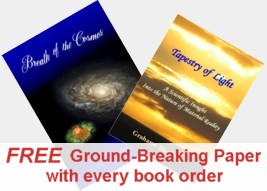
Two books that could transform your understanding of reality:
The physics of material reality as never before - in beautiful pictures and flowing poetry. A radically new, but ages old, perspective on the nature of material reality. A layman's view of the scientific issues. In these books Dr Grahame Blackwell presents, in two quite different styles, his findings from ten years of scientific investigation and careful mathematical analysis. (No maths in either book.) [Full maths available here]
Check out the blog.
Here you'll find everything from the Marx Brothers to singing bowls, from grass-hoppers to goldfish - and much, much more - all in the name of science.
"The perfect balance of new science, humour & helpful info that people can relate to in their lives", "I am impressed! I found it easy to read, not boring at all! very interesting and have subscribed for more!", "clear and precise, easy to read and acutely interesting. I like the user-friendly presentation. I have subscribed!" Subscribe free for notifications of new postings.
|
Time, Light and Consciousness: Time as a Subjective Experience of Consciousness, Material Reality as a Manifestation of Light. As published in the journal of the Scientific & Medical Network,
'Network Review', Issue 95,
December 2007. Ten years of personal research and insights from nature have led Grahame Blackwell to a radically new perspective on material reality, substantially supported by mathematics and well-established findings of 20th century science. Here he presents some aspects of that new perspective, condensed from his books published by Transfinite Mind Ltd. [Editorial note, added Sept. 2010: Some readers may wish to fast-forward to the final section - entitled 'Finally' - or even the final paragraph, to see where the article is heading before returning to the start.] [Download free PDF.] Time: what it is and what it isn't Before embarking on any discussion on the nature of time it's necessary first to define which of the dozen or more semantically different usages of that word is being considered. In the present context 'time' is used to describe the continuum which mediates those changes sometimes referred to as 'ageing' – whether that ageing be of a living organism, a rock or a star. In this context 'time' also embraces the transition from a pendulum swinging left to that pendulum swinging right, from a raindrop leaving a cloud to that raindrop reaching the ground, both within that continuum (not as a limited duration, that's a different application of the word 'time'). This usage of the word is, insofar as it can ever be, objective rather than subjective. Contrary to popular belief, time is not a physical spatial or pseudospatial dimension, comparable to those of height, width or depth. The concept of four-dimensional 'spacetime' was popularised by Einstein, having originated with his tutor Minkowski under the name 'world'. The idea that a person, a rock or a star experiences the process of ageing purely as a consequence of moving in a particular 'direction', though superficially attractive, is somewhat bizarre when considered carefully from the scientific viewpoint. Having said that, it has to be said also that, when considered from the relativistic perspective (i.e. in respect of motions near to the speed of light), time does indeed fit a mathematical model that casts it in the role of the fourth dimension. This with the proviso that it's treated in a non-standard way involving the imaginary multiplier i, the square root of minus one ('imaginary' being the mathematical term used to describe such numbers), as it is in relativity theory. In this sense time can be seen, for analytical and calculation purposes, as a 'virtual dimension'. In actuality, though, time is of course not a direction but a process (though it can't be denied that time has a very real directional quality, the so-called 'arrow of time'. More on this later). As we'll see, the process of time is the process of consciousness moving along energy lines. Those energy lines correspond to what is normally referred to as light or, more generally, electromagnetic radiation. This is why light has a universally-limiting speed, normally referred to by the letter c. This speed is in fact the rate of the movement of consciousness along those energy lines: it's long been accepted that the 'speed' of time is c, this fact is written into all relativistic formulae and transformations. Time as a process of energy flows So how can the movement of consciousness along such energy lines produce the perception of the phenomenon of ageing or, more generally, time-perception? First we need to see how the effects of time are actualised by the flow of energy along those lines. This is actually remarkably simple. Quantum mechanics tells us that matter is, in some way at least, an energy-wave construct. Matter is in some sense composed of energy waves constantly cycling in particular locations – the position of each particle of the material object. If that object moves then the energy waves comprising the particles of that object also move linearly, as well as continuing their cyclic process that forms those particles. It follows, as night follows day, that any transformative process – ageing - affecting the particles of that object will be carried around them by those energy waves. Any interaction between particles within the object will be mediated by energy transfers between those particles – transfers between those cyclic energy flows. Any effect on an object from its environment will also be a direct consequence of energy interchanges between the particles of the object and those of its environment, in addition to any free energies within that environment. In other words, any time-based effect, whether it be within a particle (such as linear motion, oscillation, or decay of that particle), within a system of particles (i.e. a material object) or within a larger system (an environment containing a number of material objects – including, for example, constituent molecules of an atmosphere) is wholly and solely due to the energy flows within, between and around the particles in question. This perspective on time and matter leads to some interesting results. First, it can be established that time acts in a way that gives it the appearance of being a 'direction' that is perpendicular to all spatial directions. The inclusion of the imaginary factor i in relativistic equations highlights the fact that this description is in some way inside-out. Rather than objects moving through time, time moves through objects in the form of energy flows. Second, it can be shown that the energy flows comprising particles of matter are in fact electromagnetic waves travelling at the speed of light. In other words every particle of matter is nothing more or less than a complex of light-flows moving cyclically rather than linearly. This result, together with the view of time as being a consequence of those energy flows, leads directly to the constancy of the speed of light as experienced in all constant-velocity states of motion. This result can be rigorously proved mathematically for all speeds and directions of motion; no other perspective on time and light (including Einstein's Theory of Relativity) has ever provided such a proof. Third, this perspective also leads directly to both the relativistic time dilation (slowing down of time at near-light-speed) deduced by Einstein and the transformation equations defined by his contemporary Lorentz for shifts in perspective at high speeds. Again, both of these results can be proved rigorously as a consequence of this description of time and matter. Fourth, consideration of the Lorentz transformation equations from this perspective provides a solid scientific basis for the constancy of fundamental laws of physics regardless of velocity - Einstein's Principle of Special Relativity, deduced by him but never previously given a mathematical basis or rationale. Last, but by no means least, it provides solid mathematically-based scientific explanations for what mass is, what causes inertia, why the mass of an object increases as its speed increases, why no material object can travel faster than the speed of light – and why E = mc2. Perhaps the most significant aspect of this new perspective, though, is its elimination of an unproven assumption of Relativity Theory, one that has led to considerable controversy over the past hundred years and generated a whole field of paradoxes. In essence, rather than 'objects' following a host of differently oriented time-lines that intersect at 'events', the energy-flow perspective shows every element of the cosmos to be synchronised to a shared universal meta-time, orchestrating the flowing movements and transformations of energy patterns that we perceive through our limited senses as separate entities. The varying time-experiences of those entities, be they living organisms or inanimate constructs - from a sub-atomic particle to a galaxy - are seen to be subjective derivatives of that one objective universal time-flow, the ubiquitous flow of energies that make up both those entities and their environment. All of these results are demonstrated clearly in non-technical terms and a simple mathematical overview given in the two books and scientific paper, respectively, referenced at the end of this article. The Arrow of Time Two known scientific facts appear to be at odds with each other. First it's known that the total energy of a system after any event is equal to the total energy of that system before that event (this includes any energy released by, or absorbed as, mass in a nuclear event in accordance with Einstein's mass-energy equivalence relationship). So it seems reasonable that any event may happen in either direction – any event should be reversible. However it's also known that this is not the case: a broken vase won't leap off the floor and reassemble itself on the table, filling with water from the puddle on the carpet as it goes; a tarnished silver candlestick won't spontaneously throw off its oxide coating and become bright again. These fundamental aspects of time are very much one-way. Why so? If the energy books balance equally in both directions, why do the workings of the universe so clearly favour one of those directions and shun the other? Again, the answer is very simple and again it's down to those energy flows. Whenever a situation arises in which some energy is surplus to requirement, that energy is released as light, sound, heat or motion of one or more particles. All of these forms of energy are by their nature dispersive, that is, they may scatter in more or less random directions away from the event that has given rise to their release. The amount of energy is the same, but bringing that energy together into a particular form may not be at all easy – it certainly won't happen as a natural course of events. This is easy to see in the case of a vase falling on the floor. The kinetic energy of the falling motion of the vase is transferred to the floor as vibration, sound and possibly a small amount of heat, all of which are rapidly dissipated. Less obviously, some of the energy that cycles through the particles of the vase, ensuring its structural integrity, is also converted to sound and heat as the vase breaks – both of which are quickly dissipated through the surrounding environment. To create the reverse of this event nature would have to engineer directed flows of energy from the environment precisely focussed to reinstate the structure of the vase and give it kinetic energy of motion up towards the table-top (and that's not even considering the water). This is asking rather too much of the random energies that swirl and surge around us - heat, light, sound, motion of the atmosphere. Imagine pouring the contents of a bottle of ink into a turbulent mountain stream. The amount of ink doesn't change – but the chances of it obligingly all pouring itself back into another bottle held 100 yards downstream are pretty slender. Random flow has the innate tendency to transform order into disorder. This is the one-way street of the arrow of time, often referred to as 'entropy' (more properly 'increasing entropy', as entropy is a measure of disorder). This same process, though, is also responsible for creating successively greater levels of complexity, from the first hydrogen atoms to larger atoms to molecules to the self-sustaining self-replicating molecular structures that have given rise to organic life in all its myriad forms. Evolution – of matter, of stars, of life itself – is a natural consequence of the random energy flows that direct the arrow of time. This process can be illustrated at the molecular level by considering the corrosion of metals: rust is an example that most of us are familiar with. The total energy required to sustain a molecule of iron oxide is a little less than that needed for those same iron and oxygen atoms to exist separately. So when iron and moist air meet at room temperature, iron and oxygen combine, releasing a small amount of their combined energies as heat, which is rapidly dissipated into the atmosphere. This process won't naturally happen in reverse: separation of iron from its oxide requires directed input of energy in the form of heat, as anyone conversant with extraction of iron from iron ore will know. This principle is responsible for the formation of all molecular structures in nature. A variant of this same principle is also responsible for the nuclear fusion process that drives the life-giving energy output of stars, at the same time generating heavier atoms from lighter ones, having originally started with the raw materials of just hydrogen and helium. Every aspect of the evolution of the universe is down to the tendency of free energy to disperse randomly – the arrow of time. In this way the ordering of energy originally inherent in the primordial 'big bang' fireball has decreased whilst the complexity of structure in the universe has increased profoundly. It could be said that nature has used the currency of raw order to purchase diversity and complexity of structure. The visionary scientist/philosopher R. Buckminster Fuller observed that life is a form of structure that exhibits the quality of syntropy, that is, localised reversal of entropy. It's interesting to consider what this might have to say about future levels of evolution of the cosmos. The Role of Consciousness in Time Perception At any given instant in time a snapshot of the physical state of the universe is given by the totality of the leading edges (or wavefronts) of the electromagnetic energy flows that make up all the particles and free energies in the universe at that time. (In passing it's worth noting that this may have a bearing on Heisenberg's Uncertainty Principle, since the 'position' of a fundamental sub-atomic particle will at that instant be reduced to a single point in the cyclic path of the energy flow forming that particle – which will vary in position and direction at different points in that cycle.) As time progresses successive snapshots will be given by corresponding advances in each of those energy flows. From the point of view of an eternal observer, unhampered by the temporal limitation of observing only one instant at a time, each of those energy flows will form a continuous thread weaving its way through space as it also progresses through what we call 'time'. Almost certainly our perception of three-dimensional space is a consciousness-mapping of some deeper reality, but since we're built to think in these terms it makes sense to visualise that succession of snapshots by some spatial analogy. A common model is to think of a succession of frames from a cine film or video recording, but this tends to lose the continuity of those energy flows. Perhaps a better model is that of a four-dimensional spherical crystal, growing outwards from the centre as time progresses (though of course from the eternal perspective that crystal simply is). Each instant in time is then an infinitely thin three-dimensional layer of that hypersphere, like the layers of an onion. The strands of light-energy snake outwards from the Source at the centre, weaving their intricate patterns of successive instants of reality in synchronisation with one another as they shape our ongoing cosmic destiny. Consciousness, flowing outward from the Source at the speed of light, experiences successive layers of this amazing hypersphere of light as instants of being, each perfect in its own way. This model fits the facts in a number of ways. First, the surface of a sphere has no beginning and no end, even though it's finite in size, nor does it have a centre – no one point on that surface is in any way more significant or central than any other. This would likewise be the case with the three-dimensional equivalent, a layer of the hypersphere, which fits our understanding of a finite yet endless universe in which no point is more central than any other. Second, successive layers of the hypersphere would be of increasing volume, just as successive layers of an onion are of increasing surface area. This fits with the concept of space itself increasing in volume, as is known to be the case with our own universe (as discovered by Edwin Hubble in 1929). It also gives an answer to the question "Where in our universe was the Big Bang?" The answer is of course "Everywhere and nowhere" – just as the grain of sand is everywhere and nowhere in each of the lustrous layers of the pearl that builds up around it. Third, since we are now into the realm of non-spatial dimensions we can take that a step or two (or three) further. Our perception of three spatial dimensions is undoubtedly a condensation by our senses of a higher level of dimensionality, just as every other aspect of our sensory input is condensed down to that essential for our wellbeing - such as the limited range of visual and auditory frequencies fed to us by our senses. Likewise our time-sense may be a simplified version of a more complex reality – including the possibility of a higher dimensionality that wraps time back on itself to give closure, as for our three-dimensional (or more) space. Finally … Light, being a wave, is intrinsically distributed in nature. Matter, being formed of light, is therefore also intrinsically distributed. The wave-particle duality of light (and of matter) is resolved by recognition of the fact that the whole universe is waveform in nature and that the impression of localised particulate form is a trick of subjective perception to help us conduct our day-to-day lives optimally (mind-altering drugs such as LSD give a clue on this, as does deep meditation rather more coherently). Notice that the 'particle' view only comes into play when there is observation or measurement, i.e. perception. This view is supported by quantum entanglement experiments which suggest that matter is alocal – the concept of 'locality' is in our perception, not in what we're perceiving. It's also supported by the fact of gravitation and the gravitational curvature of space – space itself is the extended being of matter beyond the localised 'core' that we perceive. The directed summation of the waves that are the extended being of each material particle in the universe also corresponds identically with the composition of a dynamically varying three-dimensional hologram – the universe is indeed holographic, in that every particle of matter is represented to some extent in every far-flung corner of the cosmos. The myriad complexities of the interference effects of those waves could also account for every aspect of the quantum soup that's referred to as the Zero Point Field, including the appearance of elementary particles that instantaneously pop into existence then almost immediately cancel each other out again – just as the waves on the ocean throw up particles of froth that disappear almost as soon as they're formed. And so, like the magician whipping away the cloth, we can kick away the perceptual props of spatial and temporal dimensions completely to reveal an amazingly complex and beautiful multi-dimensional highly dynamic energy field in which none of the dimensions are of space and time but rather characteristics of this energetic gestalt, unlimited in time or space, since time and space have no meaning in this context. Welcome to eternity. Welcome to your home. - - - - - - - - - - - - - - - - - - - - - - - - - - - - - - - - - - - - -
|